
Illinois’ New E-Bike and Scooter Rules Are Here — What Changed, and What Your Town Should Check
Illinois has new statewide rules for e-bikes, e-scooters, and other low-speed devices — and municipalities may need to take a fresh look at their local ordinances. The new law creates a more uniform framework for how these devices are classified, where they can operate, and when licensing, registration, and insurance requirements apply. For local governments, the question now is whether existing ordinances still align with state law and give law enforcement clear guidance.
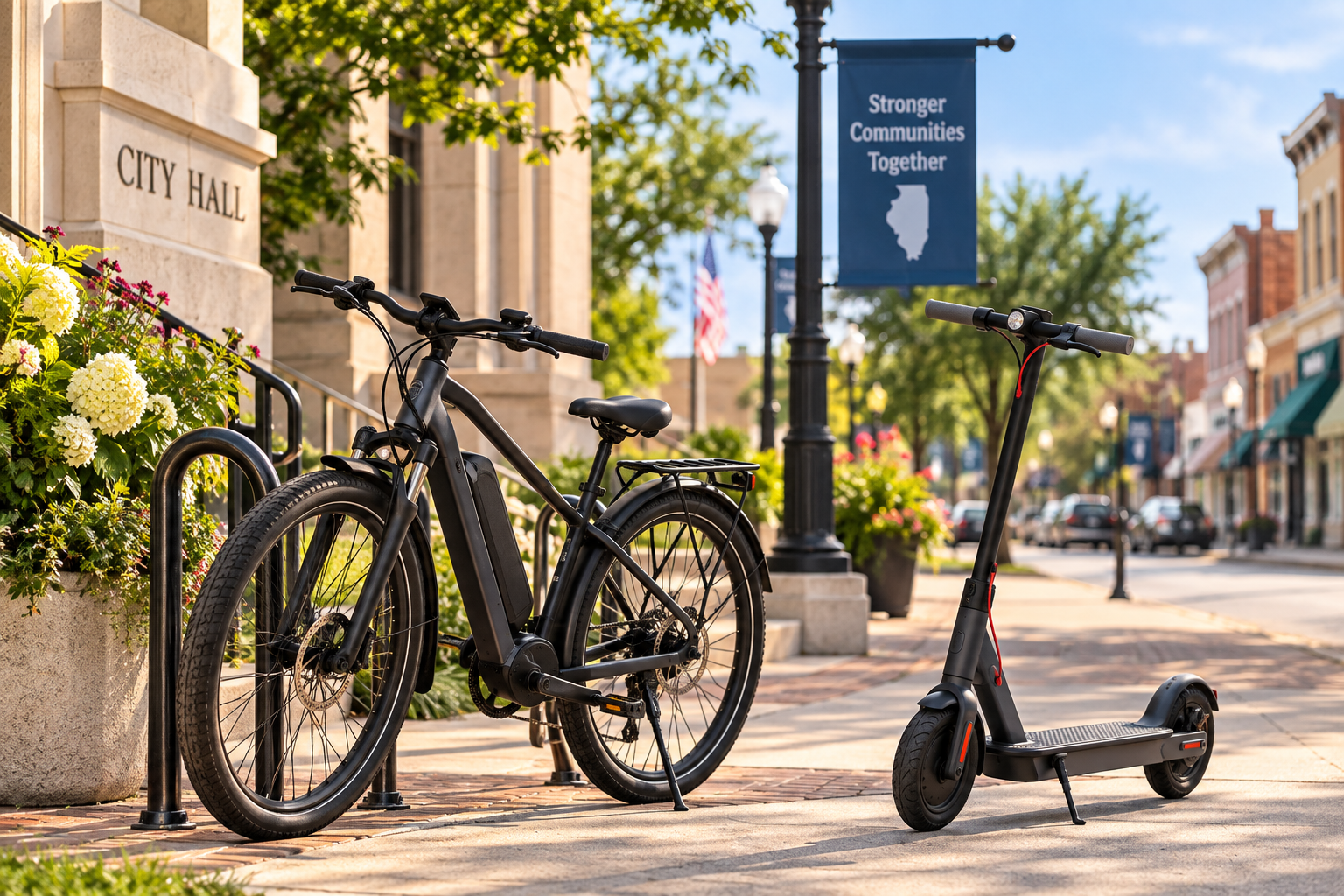
The Gap the State Was Trying to Close
Until now, Illinois had a clear three-class framework for standard e-bikes, but essentially no statewide rules for the higher-powered, higher-speed devices that have shown up on sidewalks and bike paths in recent years — e-mopeds and similar micromobility devices capable of speeds well beyond a typical e-bike, some over 60 mph. That gap left municipalities patching the problem locally, often with a mix of ordinances that didn't line up with what neighboring towns or the state were doing.
What the New Law Does
Senate Bill 3484 (part of the Secretary of State's statewide micromobility safety initiative) took effect July 1, 2026, and sets a uniform framework across three broad areas:
Standard e-bikes (Classes 1–3): The existing classification system — pedal bikes with motors up to 750 watts, topping out around 20–28 mph — stays in place, with a new minimum age for riders.
Higher-speed devices: E-bikes, e-mopeds, and similar devices capable of exceeding 28 mph are now treated much more like motor vehicles — riders need a valid driver's license, and the device needs title, registration, and insurance.
Where devices can operate: Covered low-speed devices are generally limited to bike lanes, bike paths, and roads with posted speed limits of 35 mph or less; on faster roads, they're restricted to where a bike lane is available.
The bill text and current status are on the Illinois General Assembly's website if you want to read the exact statutory language.
What This Means for Your Town
We've already had several municipal clients ask how these new rules affect their local ordinances. If your municipality has adopted regulations on e-bikes or scooters over the past few years — sidewalk restrictions, local age or speed limits, curfews in parks — now is a good time to review them before an enforcement issue arises. A local rule that's more restrictive than state law can still run into preemption questions depending on how it's written, and an ordinance that's silent on the higher-speed devices covered here may need updating so your police department has clear authority to enforce it.
Here are three questions I'd ask if I were reviewing a municipal code today: Does it define these devices consistently with the new state classifications? Does your police department have guidance on when a rider needs a license, registration, and insurance versus when they don't? And if residents have been asking about scooters and e-bikes on your sidewalks and trails, does the ordinance actually match what's now allowed under state law?
We're happy to review your existing ordinance against the new state framework and flag anything that needs to be updated before it becomes an enforcement headache.
Questions about how this affects your town specifically? Call our Mackinaw office at 309-359-3461 or our Morton office at 309-266-6211.